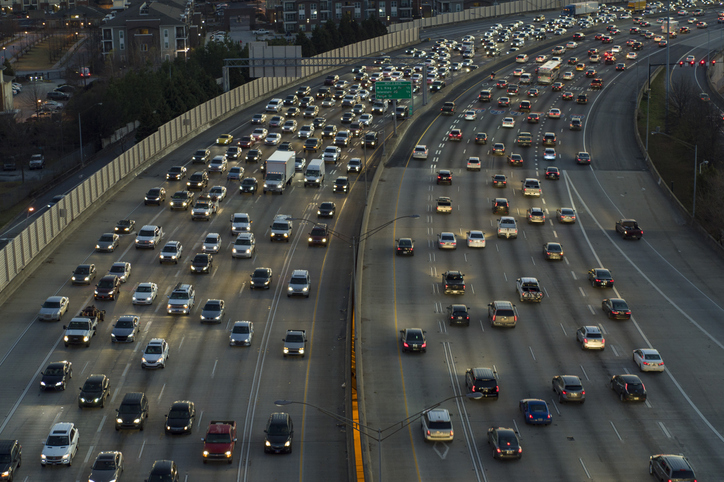
Atlanta’s reputation as a city of perpetual gridlock has reached a new level in recent years. According to the Texas A&M Transportation Institute’s Urban Mobility Report, Atlanta consistently ranks among the top ten most congested cities in the United States, with drivers spending an average of 74 hours per year stuck in traffic delays.
While the economic costs of congestion are well documented, a less visible but equally serious consequence has emerged: the rising frequency and severity of vehicle collisions on both highways and surface streets throughout the metropolitan area. As traffic volume increases and commute times stretch longer, Atlanta’s roadways are becoming pressure points for accidents that can alter lives in seconds.
When Volume Meets Vulnerability
The Atlanta Regional Commission reports that the metro area’s population has grown by more than 20% over the past decade, adding hundreds of thousands of vehicles to roads that were never designed to handle such sustained capacity. Interstates 75, 85, and 285—already notorious for congestion—now see daily traffic volumes that routinely exceed design thresholds.
But it’s not just the highways. Surface streets in neighborhoods from Buckhead to East Atlanta are experiencing increased cut-through traffic as drivers seek alternatives to clogged interstates. This shift has introduced higher speeds and unfamiliar drivers into residential areas, elevating risks for pedestrians, cyclists, and local residents.
The Human Cost Behind the Statistics
The National Highway Traffic Safety Administration emphasizes that congested urban environments create unique hazards. Stop-and-go traffic, frequent lane changes, distracted driving, and driver fatigue all contribute to collision patterns that differ from those seen in rural or less populated areas.
In Georgia specifically, data from the Governor’s Office of Highway Safety shows that Fulton and DeKalb counties—the core of metro Atlanta—account for a disproportionate share of the state’s serious injury crashes. These incidents often involve rear-end collisions, sideswipes, and multi-vehicle pile-ups that can leave victims with injuries requiring extensive medical treatment and long-term rehabilitation.
The physical injuries are only part of the picture. Medical bills, lost wages, vehicle damage, and the emotional toll of recovery create compounding challenges that many accident victims are unprepared to navigate alone.
Complexity Beyond the Crash Scene
What complicates matters further is that determining responsibility in Atlanta’s congested traffic environment is rarely straightforward. Factors such as inadequate road maintenance, poorly timed traffic signals, construction zone hazards, and even third-party negligence can all play a role in how and why a collision occurs.
Insurance companies are well aware of these complexities and often approach claims with scrutiny designed to minimize payouts. Victims may find themselves facing lowball settlement offers, claim denials based on disputed fault determinations, or prolonged negotiations that drain both time and energy.
This reality has made legal guidance an increasingly important consideration for those affected by serious collisions. For many Atlanta residents, consulting experienced car accident attorneys in Atlanta becomes not just advisable but essential—particularly when injuries are severe, liability is contested, or insurance coverage proves insufficient.
Infrastructure Under Pressure
City and state transportation officials have acknowledged that Atlanta’s infrastructure has struggled to keep pace with growth. The Georgia Department of Transportation has committed billions to expansion projects, but construction itself introduces new hazards: narrowed lanes, shifting traffic patterns, and altered sight lines that require constant driver vigilance.
Construction zones are particularly dangerous. The Federal Highway Administration has noted that work zones see a higher rate of accidents per mile traveled compared to non-work zone areas, a trend evident on Atlanta’s perpetually under-construction highways.
A Shift Toward Prevention and Accountability
Public awareness campaigns, improved road design, and stricter enforcement of distracted driving laws have all been proposed as solutions. Yet even with these measures, the sheer volume of vehicles on Atlanta’s roads means that collisions will continue to be a daily reality for the foreseeable future.
For those involved in serious accidents, understanding their rights and options has become as critical as the immediate medical response. The long-term impacts of a crash—whether physical, financial, or emotional—often extend far beyond the initial collision, making informed decision-making essential during what is already a vulnerable and stressful time.
Atlanta’s traffic may be an unavoidable part of life in one of the nation’s fastest-growing cities, but the consequences of that traffic need not be faced alone.









Leave A Comment